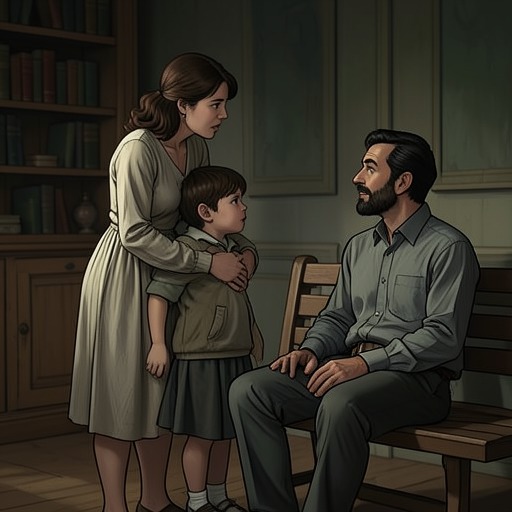
Tess Durbeyfield and Joan Durbeyfield
Tess of the d'UrbervillesThe relationship between Tess Durbeyfield and Joan Durbeyfield turns on a painful difference over what a daughter owes a future husband: protection through silence, or honesty even at the risk of losing him. Joan advises concealment because she believes disclosure will harm Tess’s prospects and happiness; Tess ultimately confesses, unable to accept a marriage founded on what she feels would be a deliberate evasion. Their clash exposes affection shaped by unequal judgments of sexual experience, as well as the distance between a mother who treats the past as a passing trouble and a daughter for whom it remains morally urgent.
A Mother’s Counsel
When Tess asks her mother for guidance about her coming marriage, Joan replies by letter. She is glad that Tess is soon to be married, but gives a firm answer to the question of whether to reveal her “Bygone Trouble”: Tess must not say a word. Joan presents the advice as private and emphatic, not tentative counsel. She argues that many women, including women of high standing, have endured trouble without announcing it, and that Tess has no reason to “Trumpet” an event that was not her fault.
Joan also invokes an earlier promise. Because she knows Tess as someone who tells everything in her heart, she had made her promise never to disclose the matter, claiming that she had Tess’s welfare in mind. She has kept the trouble from Tess’s father as well, fearing that he would repeat it indiscriminately. The letter thus shows Joan trying to manage not only Tess’s decision but also the family’s exposure to gossip and the consequences she expects disclosure to bring.
Her counsel is practical, but it rests on a view of the past unlike Tess’s. Joan regards the experience as something that happened to her daughter, not as a wrong that must be placed before a husband for judgment. Tess recognizes that her mother does not see life as she does: to Joan the old episode is a passing accident. Yet Tess also considers that her mother may be right about what course would best preserve her beloved’s happiness, even if Joan’s reasons are not wholly persuasive to her.
Silence and the Marriage
Joan’s letter changes the weight of Tess’s decision. Tess feels steadied by the instruction of the only person she believes has any shadow of right to control her action. The responsibility seems shifted from her, and her heart grows lighter. After she accepts the advice, the declining autumn days beginning in October become a period of unusual spiritual exaltation.
That relief coexists with an idealized vision of her husband. Tess trusts him completely, regarding him as a guide and friend and seeing in him exceptional goodness, wisdom, and beauty. Her love sustains her dignity, while she reads his love as compassionate and uplifting. The contrast matters to her choice: the more nearly she imagines him as an ideal moral presence, the harder it becomes to withhold a truth she believes bears directly on their union.
Tess eventually tells him despite the advice she had accepted. When she returns to her mother, she explains through sobs that Joan had told and written to her not to tell, but that she could not help herself; after she disclosed the past, he went away. The confession has therefore brought about precisely the loss Joan feared. But Tess does not present her decision as a change of mind or a careless betrayal of her promise. She says that, if the choice arose again, she would do the same: she could not bear to sin against him by trying to blind him to what had happened.
Reproach and Recognition
Joan’s first response is sharp. She calls Tess a fool, and Tess repeats that she knows she has done what her mother warned against. The exchange lays bare a conflict in their standards: Joan measures the decision by its likely consequences for the marriage, while Tess measures silence against the honesty she believes she owes her husband. Neither misunderstands the immediate outcome; they differ over what duty required when Tess had to choose.
The scene gives physical force to the rupture and to the continuing attachment between them. Tess crosses to Joan, lays her face against her mother’s bosom, and bursts into tears. Joan, agitated, splashes both herself and Tess as she exclaims. Tess is shaken so badly that she cannot continue and sinks helplessly into a chair. Her return is not simply an appeal for approval: she brings the loss back to the person whose counsel she had followed and whose authority had briefly made the decision feel bearable.
Joan’s reproach soon mixes with grief and apprehension. She laments that Tess did not keep the matter secret until her husband could no longer discover it, and worries about what Tess’s father will say. He has been talking at Rolliver’s and The Pure Drop about the wedding and the family’s recovery of its rightful position through Tess. The marriage had become, in his imagination, a route to restored family standing, so its collapse threatens more than Tess’s private happiness.
A Shared Misfortune, Unequal Understanding
After the first disappointment, Joan responds to the broken engagement much as she had responded to Tess’s earlier trouble: as an external misfortune that has come upon the family regardless of desert or folly, to be borne rather than treated as a lesson. This habitual acceptance gives her a measure of sympathy, but it also marks the boundary of her understanding. She can absorb disaster as something that happens to people without fully entering Tess’s sense of why concealment would have been morally intolerable.
The episode therefore complicates Joan’s earlier advice without erasing its care. She had urged silence because she thought it would protect Tess, and Tess herself had briefly found relief in letting her mother’s command settle the question. Yet when the cost of disclosure becomes real, Tess still believes truth was the only action she could live with. Their bond holds through reproach and sobbing, but the maternal counsel cannot reconcile the different meanings each gives to the past: for Joan, a trouble that need not be announced; for Tess, a truth she could not hide from the man she loved.